

The Fundamentals for a Better Life:
Eat, move, sleep
I know.. I know..
We’re starting with the boring ones, and yes, you already know them.
But. Most people aren’t doing them consistently, and that’s the whole game.
“Food, movement, and sleep” are basically the three buttons that control your energy, your mood, and your ability to handle everything else.
Means if you get them right, everything gets easier., but if you skip them you will be fighting uphill with every other tip on this list.
This sounds cliché until you realize that your so-called “bad” days almost always start with “bad sleep”
Take notes
Write down every attempt, every result, every lesson.
Why? Because a failure you don’t record is a failure you will repeat. No reason to overcomplicate it.
Get comfortable with failing cheaply
Failure is not a verdict. It is data you paid for.
Every flop tells you what the market doesn’t want, what you are bad at, and what to try next.
The people you look up to all have a long, invisible trail of failed attempts/ideas behind them.. You only see the one that landed.
The rule: keep the cost of each failure small so you can afford to take a lot of swings.
Routine over willpower:
Same wake-up time. Same basic breakfast. Same work block. Every decision you remove from your day frees up energy for the stuff that matters.
Willpower is a limited resource, and routine is how you stop spending it on nonsense.
Stop waiting for passion
You’ve heard it a million times: “follow your passion.”
Forget that.
Passion usually shows up after you start getting good at something, and results begin to come. Success creates passion far more often than passion creates success.
The “passionate” people you see are often just the ones who happened to win.
Pick something with real ROI, get decent at it, and let the enthusiasm catch up.

First Things First:
Health
Time
Money
Health is the one that holds up everything else. If your body is breaking down, you lose the time and energy to build anything, including income. Time comes second, because it’s the only resource you can’t earn back. Money comes last, because it’s the easiest of the three to rebuild.
So when you have to choose, use this order:
Pick what makes you healthier.
Then pick what saves you time.
Then pick what makes you money.
Think of it as a chain. A healthy body gives you the hours and the drive to work. Those hours give you the chance to earn. Money then buys you better food, better care, and more free time, which feeds the first link again. Break the first link and the whole chain goes with it.
And if you keep learning, keep showing up, and keep building skills that matter, the money tends to take care of itself.
Disclaimer: This Will Change The Way You See Failure
It is one of those things that will either free you or annoy you. You have been warned.
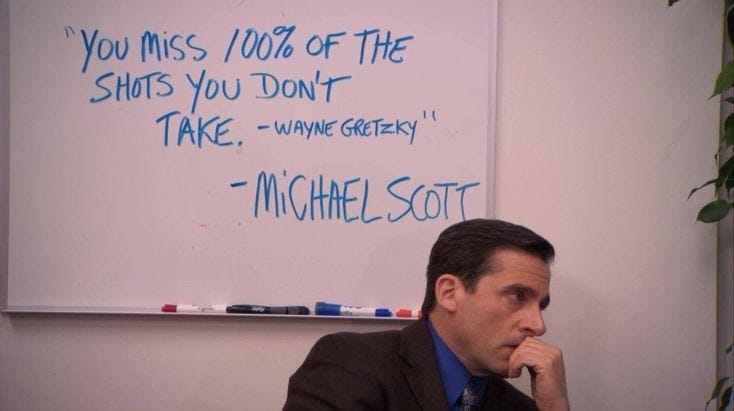
The math of trying more often:
Say you try something with a 10% chance of working.
1 attempt → 10% chance of a win
10 attempts → about 65% chance of at least one win
Now take a real long shot, 5% per attempt:
12 attempts a year (one a month) → about 46%
52 attempts a year (one a week) → about 93%
Same odds on every swing. The only difference is volume.
To be 100% transparent, real life isn’t a clean coin flip. But it is often better than this, because you learn a little each round. Most people quit after two or three tries and conclude the thing doesn’t work.
They didn’t fail. They didn’t fail enough.
Of course; This only works if you can afford to lose.
Test an idea for a weekend, not a year.
Spend $50, not $5,000. Small bets, lots of them. That way a miss is a lesson, not a disaster
Goals vs. Habits:
A goal is a finish line: “lose 20 pounds, run a marathon, make $100K.”
You either hit it or you don’t. And until you do, you are technically failing.
A habit is something you do regularly that raises your odds in the long run, with no deadline.
Lose 20 pounds → eat well every day
Run a marathon → move every day
Get rich → keep building things people want
Write a book → write every morning
When you’re chasing a goal, you feel like you’re failing until the day you finally hit it.
When you’re building a habit, you win a little every day, because showing up is the win. That makes you really hard to discourage.
Miss a goal and you’re tempted to quit. Miss a day of your habit, and you’ll still show up the next, and do what you have to.
End of the day;
You can still use goals, but as a direction. Pick a target, but don’t tie your worth to the result.
One That Should Make You Think…
The price is always there. The only question is whether you decided to pay it.
“It doesn’t make sense to continue wanting something if you’re not willing to do what it takes to get it”. —James clear
Wanting the result without the process is a recipe for disappointment.
Read that again. How many things have you been “wanting” for years without moving an inch?
Wishing is you being passive: “I’d love to be successful.”
Deciding is a trade: “Success costs X, and I’m willing to pay X.” Successful people don’t wish for it. They look at the price, accept it, and pay.
And here is the part nobody tells you: the price is negotiable
Pick the right routine and the price drops to something you can actually afford, whether that’s early mornings, boring practice, or less time on the couch.
If you read that and felt uncomfortable.. Good.
Write down what you want & what it costs in hours, money, and comfort. If you won’t pay for it? Drop the goal or find a cheaper route. Both are fine. What is not is wishing something for years without acting about it.
Stuff That Actually Works. Change Your Life:
1. Stack skills instead of making a single bet
Public speaking. Business writing. Basic persuasion. Basic tech. Basic accounting. Social skills.
Any one of these makes you decent. Two or three together make you unusually valuable, and that combination is much harder to copy than being the best at one thing.
Pick one skill to start with, and give it a little practice everyday.
Also; Try to avoid jobs that only sell your hours, and don’t prepare you for anything better.
Time is the one thing you can’t make more of. As Naval says: “earn with your mind, not your time.”
If your income only grows when you work more hours, you’ve capped yourself.
The fix is to build skills that are specific to you, and that make you hard to replace, and to find ways to use leverage, like code, content, or other people’s help, so your work keeps paying while you’re not doing it.
2. Become a decent conversationalist (start with small talk)
What you will never regret is spending your time figuring out how to build an extraordinary social life.
The world belongs to the guy who knows the guy, and you want to be that guy.
Now; Got many articles on Social Skills that you should really go through if you’re serious about becoming good with people.
For now;
Understand that Small talk is the entry point to almost everything: opportunities, friendships, deals, and help from people who don’t know you yet.
You don’t get to build rapport without first breaking the ice.
Most people like to think of small talk as useless, fake, or boring (often as a way to cope because they’re bad at it.)
Forget that.
Small talk is a skill. Means you can practice it like any other.
Start with a smile on your face. It’s the cheapest social tool you have. Instantly makes you more approachable + lifts your own mood.
Focus on “trivial/broad” subjects. Subjects where you can jump from one idea to another & keep the convo going. (setting, environment, weather, sports, etc.)
Personal tip: If you still have trouble with trivial subjects. Try instead talking to people like you’re already mid conversation. Like you’re already friends. Anything will do: Ask a question, make a supposition, give your opinion, etc.
Collect reps. Cashiers, neighbors, elevators. Low stakes, high practice.
Also; It’s important you learn to “read the room” - To notice the social cues (especially nonverbals) if someone is clearly busy or wearing headphones, leave them alone. Don’t force it on people who seem uncomfortable. A smile and a short exchange is still a win.
3. Practice your charisma. Make people comfortable being around you
“Many people think charisma is some mystical gift. But let me tell you, it’s bullshit. Charisma is just a skill.
It may come more naturally to some, but at the end of the day everyone can become decent at it.
I won’t go deeper on it here, because I already wrote a full blueprint on developing charisma.
I strongly recommend you go check it out..
4. Match the task to your brain
“Most people have a window where they are sharp and creative, and a later window where they can only handle mechanical work.
Figure out yours.
For me, I find creative work easiest first thing in the morning, when I’m at my sharpest (which is true for most people). I exercise around midday, and I save routine tasks for the late afternoon, when I’m relaxed and in autopilot mode.”
Point is; Don’t waste your best hours on email. Trust us on this: the same task takes half the time in the right window.
Do this week: put your hardest creative task in your sharpest hour for five days straight.
5. Give your spaces specific jobs
One spot for work. Another for relaxing.
Your brain learns the association and switches modes faster.
Keep the space tidy too, because clutter quietly drains your energy. Small things, big differences.
6. Simplify anything that involves other people
When communication is involved, simple wins almost every time: simple offers, simple messages, simple processes.
Complexity creates confusion, and confusion kills deals and relationships.
When a task is just you (or you and someone on your wavelength), you can afford to optimize. Otherwise, cut it in half.
7. Ask more questions
When you actually start asking, you often find three things: there’s a simple fix, there’s a website that already handles it, or there’s a professional who does it for a fair fee.
A lot of problems come from bad decisions, missing skills, or bad luck, not from missing information.
But it is surprising how many weeks you can save by asking first.
8. Be selfish in the right way
There’s a version of selfishness that is actually the most generous thing you can do: looking after your health, building your career, and still showing up for family and friends with energy left over.
Understand this: You shouldn’t spend your time making other people happy.
If you burn out, you become a burden on everyone around you.. Fill your own cup first, then use the overflow to help others.
9. Check the big five before blaming your personality
A lot of bad moods come down to a deficit in one of the big five: sleep, food, exercise, a flexible schedule, or the sense that the future is good.
Run through that list before you decide something is “wrong with you.”
Two tips to regulate your mood: Picture on purpose about your best-case future/version of yourself (the feeling is the point) + smile even when you don’t feel like it.
10. Run a food system that needs zero willpower
Don’t rely on discipline at 9pm.
Design your environment so the easy choice is the healthy one. Remove the energy-wrecking stuff from your home. Stock convenient healthy food: fruit, nuts, cheese, pre-washed veggies, cooked grains.
Notice how you feel after eating, and look for patterns (if bread or white rice makes you sleepy/bloated, test life without it).
& learn to season your food, because healthy food only gets eaten if it tastes good.
Also; If you are “hungry” but actually tired, sleep might be the real fix.
(Btw this is general lifestyle advice, not medical advice. I’m not a doctor)
11. Exercise, but don’t make it your entire personality.”
For most people; The gym is compensation, not enhancement.
For achieving a good, strong, and healthy physique: The amount of work you have to do goes up/down based on how you’re living...
You can live in a way that makes training less necessary;
Meaning 2-3 lifts/week is all you need to reach “elite” status.
Reality is; The people that meal prep, track everything, train 5-6 days a week, avoid lots of foods, etc... Have to do so because their lifestyle sucks.
You can’t, and don’t want to spend your life in the gym, considering you have other things to do (work, friends, activities, etc..)
The gym should make your life better, not take your life from you
12. Collect “small wins”
Success has a spillover effect.
Get good at something low-stakes, like a hobby or a sport, and the habit of improving carries into the important stuff.
Pick something with lots of room to progress every year.
13. Spend time with who you want to become
Behavior is contagious.
The people you surround yourself with influence you far more than you realize.
Their habits, attitudes, beliefs, ambitions, and ways of thinking gradually become part of your own behavior often without you consciously noticing it.
Spend time with positive people, and their energy tends to rub off on you.
Spend time with people who value discipline, consistency, and hard work, and it tends to rub off on you
Be intentional about it.
14. Focus on what’s for you
If you ever feel that you are “defeated”, and have lost confidence in your ability to win, sit down, take a piece of paper, and make a list, not the factors that are against you, but those that are for you..
15. Turn your life into an experiment
Treat yourself as a lab..
Notice patterns in your sleep, food, work, and mood, form a guess, test it for two weeks, keep what works.
This is the engine behind failing smart. Every small experiment either works or teaches you something.
16. Protect your schedule flexibility
Few things raise happiness as reliably as controlling your own time. When you make big career and life decisions, take your time and freedom into the equation too.
Being able to do what you want, when you want, is a freedom worth protecting
17. Care more about direction than position.
You can be in the deepest pit or riding a hot streak. Either way, the worst thing you can do is stare at the scoreboard: your bank account, your age, your weight.
The game is never over, so there’s never a final score to check.
You don’t need to have arrived to be happy. You need to be heading somewhere good.
Slow progress feels better than a comfortable plateau, and if you can’t picture an improved future, nothing in your present will ever feel good enough.
So let go of your attachment to the numbers, whether it’s money, business, followers, or weights. The moment you make a number your focus, you lose sight of what matters and become a slave to it.
Most people identify with the outcome of a single moment in time, and the second you do that, you create a zero-sum game against yourself.
18. Help others after you’ve helped yourself
Once your own health, finances, and energy are in decent shape, give back.
Your happiness depends partly on being good to the people around you. It is also one of the best long-term investments you can make.
Final Thought
The people who win big are rarely the smartest or the most passionate. They are the ones who kept their system running through a long string of misses and stayed alive long enough for one to hit.
Fail cheap/smart. Fail often. Take notes. Run the system again tomorrow.
In A Nutshell
Basics:
Eat, move, sleep
Take notes
Fail cheaply, treat it as data
Routine over willpower
Passion follows success
Have your priorities in mind:
Health/Energy
Time
Money
Something to make you think:
Failure math: more attempts, better odds
Habits over goals
Decide to pay the price (it’s negotiable)
Stuff that works:
Stack skills
Become a good conversationalist
Practice your charisma
Match the task to your brain
Give spaces specific jobs
Simplify anything with other people
Ask more questions
Be selfish the right way
Check the big five before blaming yourself
Zero-willpower food system
Exercise daily, never to dread
Collect small wins
Spend time with who you want to become
Pick the story that keeps you moving
Treat yourself as an experiment
Protect schedule flexibility
Direction beats position
Help others after yourself