

“Hell is other people” — Jean Paul Sartre
Why is everyone looking at me? Am I being judged right now? Do I look as awkward as I feel? Why can’t I just relax & be myself?
Same answer every time & (spoiler alert) it has nothing to do with other people.
Hi everyone;
Most people don’t really care about you (& that’s great news):
Let’s face it.
You know that awkward moment you still think about? The one that sometimes show up right when you’re trying to fall asleep, or hits you in the shower out of nowhere, and suddenly you’re cringing alone and asking yourself: how could I be so stupid?
You’d swear everyone saw it, and nobody will ever forget.
Now flip it. Think about the times someone else did something just as awkward in front of you.
Yeah... can’t think of much, right?
Harsh truth: “most people aren’t thinking about you nearly as much as you think they are”.
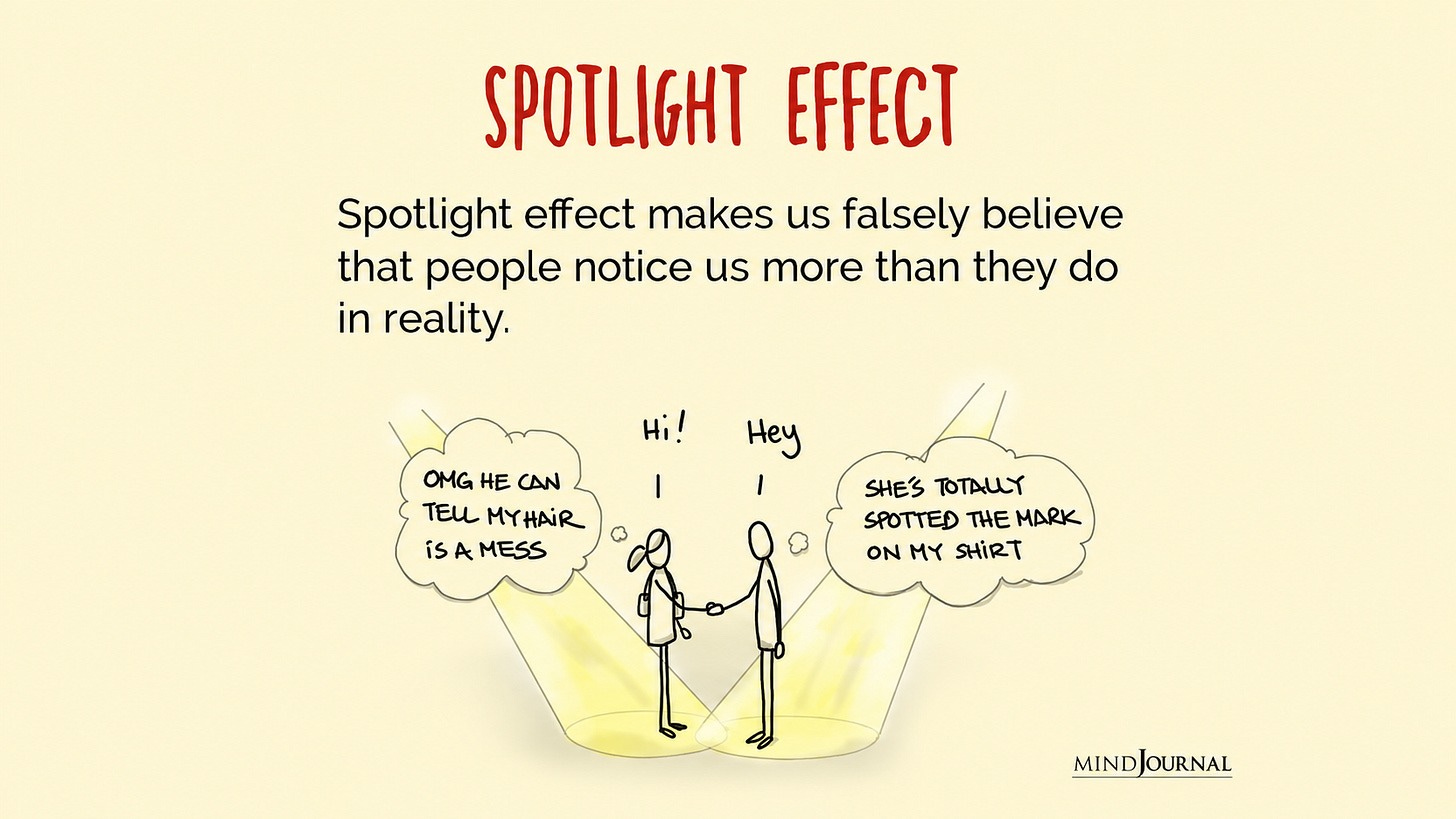
The Spotlight Effect:
A psychological phenomenon where we tend to overestimate how much others notice pretty much about us. Our actions, words, appearance, etc. EVERYTHING..
Deeper, it is an egocentric “bias” - We see everything through a “Player 1” lens and believe our perspective is the only perspective
Like you’re the “main character”, at least in everyone’s perception.
Term first came out in 2000, after psychologists did a certain experience: They asked some students to wear an embarrassing shirt (Barry Manilow), and then estimate how many of their peers they think would notice.
The results? Students estimated 50%, when in reality only 25% did.
Here’s what it looked like in case:

Two takeaways:
We think people notice everything about us, but they aren’t.
Even when they do notice, they forget about it quickly.
The Cost of the Spotlight:
This bias isn’t harmless. It quietly shapes how we live, and most of the damage is invisible, because it comes from things you didn’t do.
1. You shrink yourself:
Everywhere. All the time. You got anything you wanna share.. Maybe it’s a good idea. Maybe just a good joke.
But you start rehearsing: “”What if it’s obvious?” “What if I phrase it badly?” “What if everyone thinks I’m stupid?”
& by the time you’ve finished overthinking, people have already moved on.
Over time, the cost adds up: You get used to the idea that you shouldn’t take up too much space. You just go along with whatever people say or do, as if you didn’t deserve to be heard.
And then the price shows up: the promotion you never asked for. The idea someone else pitched three weeks after you stayed quiet. The version of you that people never got to meet., etc..
All because you always shrink yourself..
2. Self-consciousness turns into self-centeredness:
This one is uncomfortable, because it sounds like a character flaw, when in reality it’s just a bad habit..
You step into most of your social settings/interactions worried about how you look, how you sound, and whether you’re being awkward, or judged
Almost your complete focus is on yourself.
You’re not present in the moment. You barely hear people, you’re not listening to them.
People can feel that anxiety, or rather lack of presence/interest, and it makes them uncomfortable too.
3. You avoid what makes you happy:
This is the most expensive one.
The gym you’ve been meaning to join. The language you’ve been meaning to speak. The version of yourself you’ve been meaning to show. The video you’ve been meaning to post. The activity , business, or project you’ve been meaning to start. The opinions you’ve been meaning to share…
All held back by the same question: “what will people think?”
Every one of those things got put on hold for an audience that mostly doesn’t give a sh**, and will forget as quickly even if they do.
The worst part? Embarrassment fades fast. The “what if I had” stays.
Now. While It’s hard to switch the spotlight off completely, you can at least dim it enough not to affect your life:
3 Practical ways to dim The Spotlight:
1. Awareness
Detachment starts with simply acknowledging that this bias exists.
Understand that everyone is just as fucked up in some way (some are just better at hiding it).
Whatever they notice or learn about you, they forget it quickly, as they’re more concerned about themselves.
That’s just human nature for you: selfish creatures, constantly thinking about their own appearance and how they come across.
It’s important to remind yourself of that, especially in “spotlight situations”, because that’s when your anxiety tends to pop up, along with the usual signals (heart beats faster, breathing speeds up, muscles tense, etc.)
Then you feel like everyone is seeing your embarrassment, which makes it even worse.
When in reality, it’s just like the rest: people barely notice, and care even less.
So get it into your head, once and for all: it’s all in your head.
2. Shift your focus outward:
The Spotlight Effect is self-consciousness at its peak. It means you’re not present in the moment. You’re stuck in your head, worrying about what to say or what others might think of you. That’s an inward focus.
So if you want to put your anxiety to rest and quiet those voices, shift your focus outward.
How exactly? Two ways.
-Focus on others:
Get genuinely curious about the people around you. Ask questions. Listen actively. Use your eye, look at people, and notice the little cues: how their face changes, their tone, what makes them light up.
Why does it work? Because you can’t obsess over yourself while you’re busy paying attention to someone else (focus outward)
It also beats telling yourself “don’t stress”, which actually only makes you even more self-conscious.
Plus:
Showing genuine interest in others is still one of the best ways to build rapport, be more interesting, and keep a conversation flowing with no awkward silences. win win
-Focus on your breath:
The moment you feel the spotlight, your brain puts its sole focus on yourself: your face, your voice, what your hands are doing, how you look right now..
Guess what? Your breath is the still the fastest, and easiest way to pull it back.
Breathe in slowly through your nose (4sec), then let it out even slower through your mouth (6sec). That long exhale tells your body “we’re safe,” and your heart starts to calm down.
& don’t worry people won’t notice.
3. Ask “So What?”:
Before a “spotlight situation” (a presentation, a party, a difficult conversation), confront your fear head-on..
Ask yourself: “What’s the worst that could happen anyway?” Then follow every answer with “So what?”. You’ll quickly realize there’s isn’t much to fear anyway..
Say you have a presentation tomorrow.
“What if I blank in the middle of it?” So what?
You take a breath, look at your notes, and say “give me a second.” Everyone in that room has seen someone blank before, and most have done it themselves. Nobody remembers it a week later.
What if my voice shakes? So what? A few people might notice, and most will be too busy worrying about their own work to care.
Keep going until the fear has nowhere left to go.
Usually, when it becomes specific, it isn’t nearly as bad as it felt when it was vague.
As Seneca wrote: “We suffer more often in imagination than in reality.”
Two big mistakes in life:
Worrying about what other people think of you.
Believing other people think about you in the first place.
The spotlight was never really on you, which means you’re free to do whatever you want.
When the Spotlight Meets Embarrassment. 2 practical ways to handle awkward situations:

First things first: what is an “Awkward situation”, exactly?
It’s basically any moment when you feel like you’ve lost face (hit to your image) in front of other people, usually because of something unexpected: a mistake, a slip-up, etc.
Then there’s “embarrassment”, aka the feeling that comes with it. & guess what?
It feeds on the spotlight: the more you feel watched, the more embarrassed you get, and the more embarrassed you get, the more you feel watched.
So here are two practical ways to handle those moments:
1. Name “the elephant in the room”:
You’ve heard the expression — an issue/topic everyone is aware of, but nobody dares to talk about.Everyone pretends like nothing happened.
Why? Usually because bringing it up feels risky, like it could make things even more awkward.
When in reality.. It’s the complete opposite.
Listen. Pretending nothing happened, when it’s very obvious that something did, is what makes the situation even more awkward.
Everyone knows, but nobody says it.
Then you know the drill..
Everyone’s suddenly busy with their phone. Someone coughs. You catch someone’s eye, and you both look away like nothing happened. Some people smile awkwardly, others study the table, and everyone’s silently begging someone pleeaassse: “say something.
The longer it drags on, the worse it gets. And you feel every single second of it.
On the other hand; When you point out, name, or even joke about the situation out loud, the tension drops for everyone in the room, including you.
It’s like it loses its hold & can finally leave people’s minds.
Try it it next time. You’ll notice how people will appreciate you for it.
Here’s a real life example so you can visualise it:
2. Laugh at yourself first:
“What doesn’t kill you makes you stronger.” —Nietzsche
This saying is actually very accurate when it comes to awkward situations.
When something awkward happens and you freak out, people feel your anxiety, because it’s contagious, and they end up feeling just as awkward as you do
But when you’re the first to joke about it, you show that you don’t give much of a shit about it. And if you, the person most concerned, don’t care, why should anyone else?
So when something doesn’t go as planned, be the first to laugh at it.
Watch how Dakota Johnson does it perfectly here:
Fin thanks for reading me..